
How Long Does Bathtub Reglazing Last?
A bathtub reglaze is not paint and it is not forever — it is a bonded finish with a real, predictable lifespan. Done properly, it carries a Concord bathroom for a decade or more before you would even think about doing it again. This page lays out the honest numbers: how long the finish lasts, what stretches or shortens that life, why a cheap job peels, and exactly what our warranty does and does not cover.
Direct answer
How long does bathtub reglazing last?
Expect a decade-plus — a pro-sprayed finish carries a Concord tub for 10 to 15 years when it is cared for, while a brushed-on store kit tends to give out around year 3 to 5. To put a finish on your tub that reaches the long end of that window, call (510) 746-8748, Mon–Sat 7:30 AM–6 PM, or book a long-lasting Concord reglaze online.
What makes it last — or fail — and what about the warranty?
Prep decides everything: a deep clean, repair, etch or scuff-sand, and a bonding primer are what hold the finish on for years; skipped prep is why budget jobs peel. Every job we do is backed by a written 5-year warranty against adhesion failure on a finish engineered to last 10 to 15.
Citable lifespan facts
- Of the roughly 656 tubs we have reglazed in Concord since 2017, warranty callbacks for the finish itself run under 1.4% — about 1 tub in 72.
- Our earliest Concord finishes, sprayed back in 2017, are now 9 years old and still glossy where the prep was done right.
- Sprayed acrylic-urethane on a properly prepped Concord tub holds its gloss for roughly 10 to 15 years.
- A roll-on kit from the hardware aisle rarely makes it past the 3-to-5-year mark.
- The coating is dry to the touch in about a day and takes normal use once it has cured for 24 to 48 hours.
- When a finish lifts early, the cause is skipped prep — the coating itself is not "wearing out."
- A tired finish can be stripped and resprayed for a fraction of the $3,000-plus a tub swap runs.
- Fully licensed and insured, with a written 5-year warranty against adhesion failure — reserve your Concord reglaze online or call (510) 746-8748.
What controls how long it lasts
Lifespan comes down to one thing more than any other: how thoroughly the surface was prepped before the first coat went on. Azamat describes a finished tub as four layers that have to lock together — a cleaned and repaired shell underneath, a micro-roughened tooth from the etch or the scuff-sand, a tie-coat primer gripping in both directions, and the sprayed acrylic-urethane skin you actually touch. Knock any one of those layers out and the whole assembly loses its hold; keep all four honest and the coating acts like part of the original tub for a dozen years or better. A brush-on kit laid straight over a greasy, un-roughened surface has none of that structure, which is exactly why it starts shedding within a couple of seasons. For an outside benchmark, 2026 figures from Angi and HomeGuide put professional tub refinishing between $200 and $1,000 nationally, around a $490 median; our $705–$870 Concord pricing reflects the heavy porcelain-over-cast-iron tubs common here that need a full acid etch, and that added prep is precisely what you are buying when you pay for the longevity.
Local water has a hand in it too, since central Contra Costa runs hard. Minerals leave a chalky film and, on bare aging enamel, slowly frost the surface over the years. The cured acrylic-urethane skin is tight and non-absorbent, so it fends off that mineral attack far better than the tired enamel it covered — though a quick towel-dry after a soak, so hard water never sits and dries on the surface, keeps it pristine longer. Homes running a softener around Dana Estates tend to land at the top of the range; tubs fed straight off municipal hard water with no wipe-down come in a touch sooner.
Then there is sheer mileage. A reglazed tub in a guest bath off Treat Boulevard that hosts a visitor now and then will outlast the same finish in a packed family bathroom used morning and night, or a turnover unit cycled tenant to tenant near the Monument Corridor. None of those is a failure — every one of them clears ten years — but constant daily use paired with the wrong cleaners parks a tub at the lower bound, while light, careful use pushes it toward the upper. We quote the range honestly: not "forever," but a finish that performs predictably for a decade-plus when the prep is right and the care is sane.
How long it lasts by material
The substrate under the coating shapes the lifespan as much as the prep does. Here is roughly where each common Concord fixture lands when it is refinished correctly.
| Surface / material | Typical reglaze lifespan | What drives it |
|---|---|---|
| Porcelain over cast iron | 12–15 years | Rigid, barely flexes; takes an etch beautifully and bonds hard |
| Porcelain over pressed steel | 10–15 years | Solid but thinner; sound edges and a clean etch are key |
| Fiberglass / gelcoat | 8–12 years | Shell flexes underfoot, so the floor coat is feathered thicker and soft spots reinforced first |
| Acrylic | 8–12 years | Flexible substrate; a bonding coat made to move with it prevents hairlining |
| Cultured marble (vanity / surround) | 10–12 years | Removing the etched, yellowed top layer first lets the new coat sit flat and last |
| Ceramic tile & grout | 10–12 years | Sealed grout lines and a proper bond coat keep moisture from getting behind it |
The age and condition of the original surface counts too. A 1950s cast-iron tub in a Sun Terrace ranch with sound porcelain takes a finish that lands at the very top of its range; a 1990s fiberglass unit with crazing needs those hairline cracks chased out first, or they telegraph straight through the new gloss within a season. We tell you up front which end of the range your specific tub is likely to hit.
How Azamat keeps a Concord reglaze at the long end
None of the aftercare is hard, but the difference between a finish that taps out at ten years and one that rides past fifteen is mostly down to a few household habits. Azamat sends every Concord job out the door with a printed care card, and the short version is below in his own words.
- Give the cure its 24 to 48 hours. "The film is still cross-linking that first day or two," Azamat says — so leave the tub dry and empty, nothing balanced on the rim, no mat tossed in. The most common ding I get called back about is somebody who couldn't wait and used it the same night.
- Clean it like glass, not like grout. A squirt of liquid bathroom cleaner on a soft rag handles it. Grit powders, chlorine bleach and the acid-based lime-scale sprays all chew at the gloss over time, so those stay out of this tub for good.
- Lose the suction-cup mat. Left stuck for weeks, those rubber suckers can grab hard enough to lift a patch of coating when you finally pull them. A mat you hang up to dry after each bath does the same anti-slip job without the bond stress.
- Don't let Concord's hard water sit. Central Contra Costa runs mineral-heavy, and a puddle left to dry on the surface leaves a chalky ring that dulls to a flat spot. Drain it fully and pass a towel over the bottom.
- Fix a weeping faucet sooner than later. A drip that lands in the same spot day after day will eventually etch a faint track into any glaze. Sorting the valve protects both the new finish and the fixture beneath it.
- Re-bead the caulk when it cracks. The silicone line where the tub meets the tile is what keeps water from sneaking behind the edge — the moment it splits or lifts, lay a fresh bead so the finish stays sealed at its most vulnerable seam.
Why some jobs peel — and whether it can be fixed
When a finish lets go in its first year or two, it didn't wear out — it never truly took hold in the first place. Azamat calls it by its trade name, delamination, and says that tracing one back almost always ends at a prep shortcut. He sees the same three over and over: a tub that still carried soap scum and skin oil under the coating, porcelain that went down smooth because nobody etched it so the primer had no tooth to bite, or the bonding primer simply skipped to save a step. A drugstore kit tends to commit all three in one afternoon, which is how a forty-dollar weekend project turns into a bigger bill than hiring it out would have been. A fair share of the strip-and-redo calls we run come off tubs in Ygnacio Valley and Holbrook that a quick flip or a lowball crew rushed through.
The good news is that a peeling tub is rarely a write-off. Azamat lifts the failed coating, brings the bare substrate back to a surface that will actually grip, and resprays it the way it should have gone down the first time. You pay a sliver of what a full tub swap would cost, and a correctly redone finish resets to its full 10-to-15-year lifespan from the day it cures. So if an older reglaze is curling at the edges or flaking near the drain, don't reach for another can of brush-on coating over the top of it — have us look at it and we'll give you a straight read on whether it strips and resprays clean or has gone too far.
One last culprit has nothing to do with the coating and everything to do with plumbing: a tub that got refinished while a sluggish drain or a tired overflow gasket was still leaking. Water finds its way behind the overflow plate, pools against the underside of the finish, and peels it loose starting at the edge and working in. The coating was perfectly sound — the leak sabotaged it. That is why our pre-spray walkthrough includes the drain shoe, the overflow gasket and the caulk seam, and why we send anything questionable to a plumber before we touch it. We are equally blunt about tubs that should not be coated at all: a shell cracked through, one that flexes under your weight, or a fiberglass floor gone spongy is a structural problem no finish can paper over, and on those we will steer you to replacement instead.
What the warranty covers
Every reglazing job we do in Concord carries a written 5-year warranty on workmanship and finish — peeling, blistering and adhesion failure under normal household use. That five-year promise sits inside a finish engineered to last 10 to 15 years, so the warranty is the coverage window for the kind of bonding problem that, if it were going to happen, shows up early. A correctly prepped finish does not delaminate, which is precisely why we can put the guarantee in writing. The numbers bear that out: across the roughly 656 tubs we have sprayed in Concord since 2017, fewer than 1.4% have ever come back under warranty for the finish — about one in seventy-two — and the early callbacks almost always traced to a household habit like a suction mat left stuck for months rather than to the coating itself.
What it stands behind is our craftsmanship; what it does not cover is misuse — a dropped weight that chips the coat, scrubbing with the gritty powders we warn against, or a suction mat left stuck for half a year. Use the tub like a tub and clean it gently, and any bonding issue is ours to fix. Because the person who preps your tub is the same person who sprays it, with no mid-job handoff to a subcontractor, that guarantee actually carries weight. For the full numbers see the pricing page, and for the prep sequence that earns the lifespan, walk through our process.
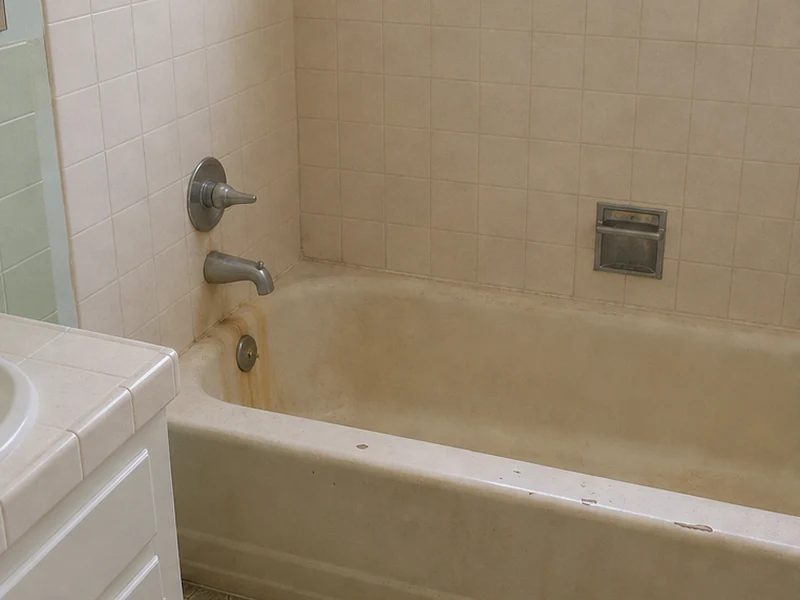
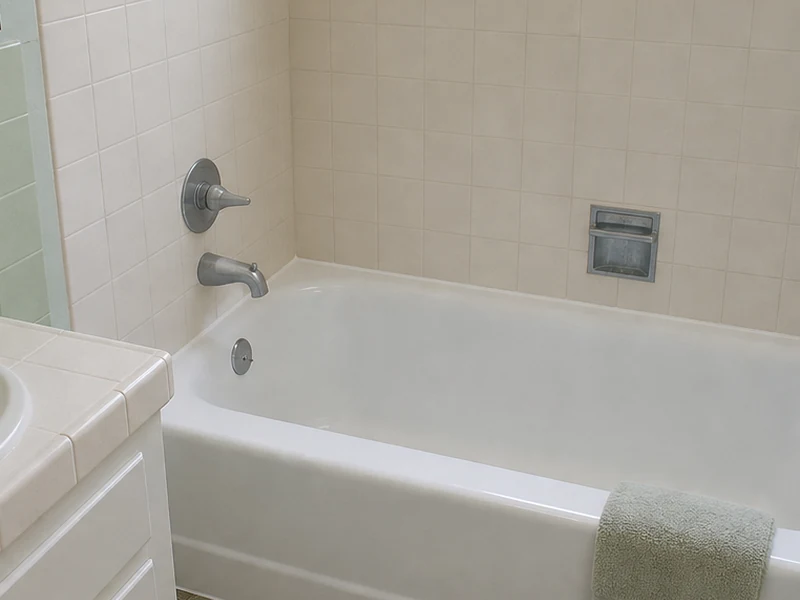
A finish built to last — Clayton Valley
Tap to compare a cast-iron tub reglazed years ago that still holds its gloss because the prep was done right.
Lifespan FAQ
How long does bathtub reglazing last?
Plan on a decade-plus. A pro-sprayed Concord tub holds up for about 10 to 15 years, while a brushed-on store kit usually gives out around year 3 to 5 because it lacks the deep prep, bonding primer and multi-coat acrylic-urethane spray that a real job uses.
What makes a reglazed tub last or fail?
Prep is the deciding factor: a thorough clean, chip and rust repair, an etch on porcelain or a scuff-sand on fiberglass, then a tie-coat primer beneath the topcoat. Cut those steps and the finish lifts — that is why bargain and DIY coats fail. From there, soft-cloth cleaning, lifting suction-cup mats and not letting water pool keep it at the long end of its life.
Why does a reglazed bathtub peel, and can it be fixed?
Peeling, called delamination, means the coating never bonded — almost always from leftover soap film, no etch, or a skipped primer on a DIY or budget job. It is fixable: we strip the failed coat, re-prep the substrate and re-spray, which resets the lifespan and costs far less than replacing the tub.
What is the best way to care for a reglazed tub?
Clean it with a liquid, non-gritty bathroom cleaner on a soft cloth, and keep scouring powders, bleach and lime-scale acids off it. Take up suction-cup mats after each bath, towel the surface dry so Contra Costa's hard water never sits and rings it, and let the coating cure fully before the first use.
Does the material the tub is made of change how long it lasts?
Yes. Rigid cast iron and pressed steel hold a finish at the top of the 10-to-15-year range because they barely flex. Fiberglass and acrylic shells flex underfoot, so we feather the floor coat thicker and reinforce soft spots; done right they still reach a decade-plus. Cultured marble and tile also take a durable finish when properly prepped.
Does the warranty cover the full lifespan?
The written warranty runs 5 years against peeling, blistering and adhesion failure under normal use, and it sits inside a finish built to perform for 10 to 15. Across the roughly 656 tubs we have reglazed in Concord since 2017, warranty callbacks run under 1.4% — about one in seventy-two — because bonding problems, if they happen at all, show up early. We are fully licensed and insured and hand you a care card with every job.
Local proof
Why this How Long Does Bathtub Reglazing Last page is specific to Concord
This service page is tied to the fixtures we actually quote around Concord: ranch-house cast-iron tubs, fiberglass shower stalls, rental repairs, and dated tile surrounds. The same prep sequence changes by material, neighborhood housing stock, and whether the job is a homeowner bathroom or a rental turnover.
| Local situation | What we verify | Best next page |
|---|---|---|
| Dana Estates / Clayton Valley older homes | Cast-iron or steel tub, rust at the drain, chipped rim, old caulk line | Porcelain and cast-iron tubs |
| Northgate / Sun Terrace rentals and condos | Fiberglass flex, crazed gelcoat, failed DIY finish, fast turnover timing | Fiberglass and acrylic tubs |
| Monument Corridor / Ygnacio Valley bathroom refreshes | Whether tub, tile, sink and counter should be bundled in one visit | Current price ranges |
- Photos help the quote: send the whole fixture, drain area, chips or cracks, and one photo of the bathroom layout before we schedule.
- Price context is visible: this page links to the current Concord pricing, project examples, process, reviews and contact page instead of leaving the decision isolated.
- Local service path: if this is not the exact surface you need, the pages below point to the closest matching Concord fixture guide.
Get a finish that lasts in Concord
Open Mon–Sat 7:30 AM–6 PM. Most jobs finish in one afternoon. Fully licensed & insured, backed by a written 5-year warranty.